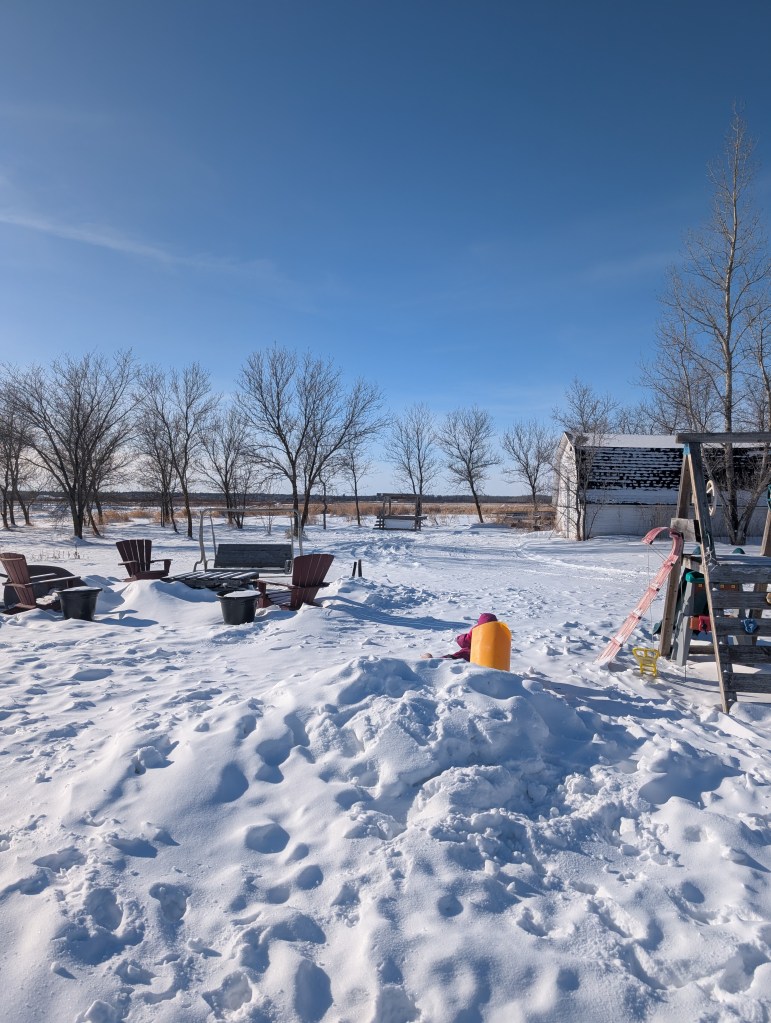
Because we live in Manitoba, spring takes a while to reach us. During the cold winter months, we turned our attention to acquiring animals for the spring. There are certain things I expected to learn when we started the endeavour into homesteading/hobby farming. For instance, I assumed I would learn a lot about the importance of proper fencing with animals, how to properly care for various farm animals, how to slaughter those animals humanely and where to go to process the meat. However, there were certain things that I did not expect to learn during this process, some which made me laugh and others that simply frustrated me to no end. Full disclosure, some of these discoveries will come as no surprise to anyone who has experience in hobby farming, but as a first-time homesteader, I was naively unaware about pretty much everything involved in the process.
To start, I had the very foolish idea that it would be easy to find animals to add to our farm. I honestly assumed that I would simply type into Google “calf for sale near me” and that I would be able to find one relatively quickly for a reasonable price. Part of the reason I believed this was because last year when we were just starting to talk about getting animals in the near future, we had asked Brent’s cousin who has cattle, and he had told us that we should be able to find a calf pretty easily and that we shouldn’t pay more than $500 per calf. This seemed like a pretty decent deal for the amount of meat we would be able to get once it was fully grown. Unfortunately for us, we could not have predicted that cattle prices would skyrocket by the next year when we started looking for ours. When we started looking, we noticed that people now are asking $1000-$1500 per calf! Not only that, but there are way fewer people offering up bottle calves and people are clearly jumping at the chance to get them, thus justifying the price. As we continue looking, we are faced with the not so fun prospect of having to spend double what we had intended and then add on the fact that some of these cows are 2.5-3 hrs away from us. Brent remains confident he can find a cow for cheaper, despite the fact that when he posted an add on one of the cattle selling pages saying “$500 cash for a calf, will pick up today” most of the responses included people telling him he was dreaming or that he needed a time machine.
Despite Brent’s confidence to be able to find a calf for a good price, we started discussing the idea of getting a yearling. For those unfamiliar with cow terminology a yearling is a cow between one and two years old that hasn’t had her first calf. This was disappointing to me because I had hoped to have the experience of a cute little cow that the girls and I would be able to feed with a bottle and bond with before the inevitable slaughtering time. Now, my mother questioned whether that would perhaps make it harder to kill and eat and that the girls might not be happy when their cow was gone. I would like to be clear that we have had full discussions with Cece about the process and explained that we want to make sure that the meat we are eating was treated well before it was killed and didn’t come from a feedlot. Penny is still too young to really understand so I am sure we will have some tears there for sure. This led to some new discoveries when we were looking at older cows, either male or female because at this point, we aren’t as picky. The funniest discovery I made was how the male cows that were up for auction were detailed in their write up. They always mention the birth weight, what breeds their parents were and then, if they are being sold as potential breeders, they list their scrotal circumference…The first time I saw this I couldn’t help but laugh. I was just not at all prepared for the idea that it would be something to even consider. This also led me to questioning who has the unfortunate job of having to measure something like that? Also are buyers actually going to get out a measuring tape to confirm that it is accurate? I am assuming that seeing as it is listed on many of the breeder bull write ups that it is something that is often considered when purchasing a bull, but I think I can confidently say that it will never be on our checklist when purchasing any future cattle.
With cattle seeming more and more expensive and in short supply, I decided to turn my attention to my animal of choice, as well as Penny’s, sheep. In my mind, they are so cute and fluffy. I have seen several Instagram reels about curious and rambunctious sheep, most notably the little black-face sheep. Obviously, I was curious about whether or not we could get some black face sheep and quickly discovered that they were called Valais Blacknose sheep. In my mind, this name is deceiving because it isn’t just their noses that are black, but alas, that is their name. I had seen some ads for other breeds of sheep, and they all seemed to be asking between $80-$150 per lamb. This seemed extremely reasonable, especially after seeing the prices for cows. I figured, if regular sheep were $150, then a special cute breed like the Valais, would probably be maybe $300. Oh man was I wrong! On the Valais Blacknose site that sells out of Manitoba, they were asking $35,000 for one of their rams! And yes, I checked the numbers several times to make sure I read it right, and no I did not mess up on my decimal point typing this out. I could not wrap my head around how someone, would willingly pay that much money for a sheep. Now I am sure, if I looked around and did more searching, I could find some for slightly less, but still the idea of spending tens of thousands of dollars on a sheep just blew my mind. Thankfully, one of our neighbours down the road has some pregnant ewes and we are on standby for some lambs.
Finally, I discovered that there is a wide range of animals that fall under the “livestock Manitoba” search on Kijiji. I found many people selling rabbits, which I know the girls would love to have, but Brent and I have agreed it will never happen. We told the girls that they technically have a pet bunny that we see in our front yard all the time. To make it feel more like their own pet, we told them to name the bunny, so we now say hi to Dandelion most mornings as she or he, really who knows, eats their breakfast in the morning. I made the mistake of letting the girls look with me through the ads once and they saw that someone was selling ostrich eggs for hatching and included pictures of the fully grown ostriches. This created terror in Cece and Penny got upset when I said we absolutely could not buy an ostrich. The variety of birds available is astonishing, and also unsettling for me as someone who really dislikes birds. The girls wanted all of them. That was until they saw the goats, dwarf goats, mini horses, mini donkeys and at one point a mini highland cow. That last one was the hardest for me to say no to, because I would love to have a highland cow, mini or full-sized. We even looked up some mini highlands at one point, and they were hardly better than the Valais sheep. They wanted $25,000 for one mini cow…I did eventually find a more reasonably priced site that was asking only $3500 per calf, but still a lot to pay for a pet.
Despite all these high-priced animals and scarcity of calves, this has not deterred us one bit from wanting to start our farm. Brent has purchased the fencing; we’ve been mapping out our acreage and I have spent many nights reading about what is required to raise bottle-fed lambs. I am still excited to get to raise some animals and get to teach my girls how to take care of them as well. I am confident that at some point in the future, when I am much more knowledgeable about farming, I will look back at these days when I was naïve and laugh about my shock and surprise with the details of purchasing animals. But for now, I will always laugh at the idea of some poor worker whose job it is to measure the scrotal circumference of the bulls going up for auction.
 The Hopeful Homesteader
Leave a comment